


时钟
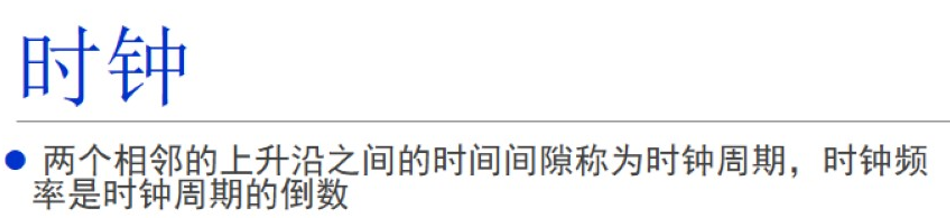
时序逻辑电路的动力, 周期性的输出0或者1
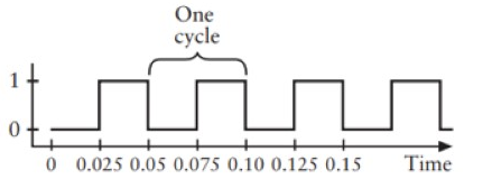
下图时钟周期是0.05, 对应的频率是20HZ
- 时钟可以同步不同的部件
- 控制电路
- 时序控制
一位多路选择器的实现
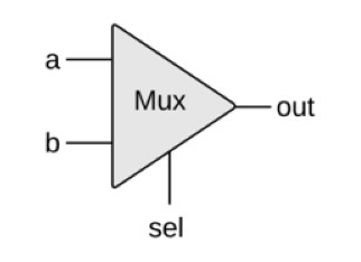
从多路输入中选择一个作为输出
代码实现
`ifndef MUX_V
`define MUX_V

`include "a_not.v"
`include "a_and.v"
`include "a_or.v"

module mux (output o, input a, b, input sel);
    wire n_sel;
    a_not not1(n_sel, sel);
    wire val1, val2;
    a_and and1(val1, a, n_sel);
    a_and and2(val2, b, sel);
    a_or or1(o, val1, val2);
endmodule;

`endif
测试
`include "mux.v"

module mux_tb;
   reg a, b, sel;
   wire out;

   mux obj(out, a, b, sel);

   initial begin
       // 将 $monitor 放在最开始,确保能监控到所有变化
       $monitor("Time=%0t: a=%b, b=%b, sel=%b, out=%b", $time, a, b, sel, out);

       a = 0; b = 0; sel = 0;#10;
       a = 0; b = 0; sel = 1;#10;
       a = 0; b = 1; sel = 0;#10;
       a = 0; b = 1; sel = 1;#10;
       a = 1; b = 0; sel = 0;#10;
       a = 1; b = 0; sel = 1;#10;
       a = 1; b = 1; sel = 0;#10;
       a = 1; b = 1; sel = 1;#10;

       $finish;
   end
endmodule
16位多路选择器的实现
输入输出都是16位
代码实现
`ifndef MUX16_V
`define MUX16_V

`include "mux.v"

module mux16(output [15:0] out, input [15:0] a, b, input sel);
    mux m0(out[0], a[0], b[0], sel);
    mux m1(out[1], a[1], b[1], sel);
    mux m2(out[2], a[2], b[2], sel);
    mux m3(out[3], a[3], b[3], sel);
    mux m4(out[4], a[4], b[4], sel);
    mux m5(out[5], a[5], b[5], sel);
    mux m6(out[6], a[6], b[6], sel);
    mux m7(out[7], a[7], b[7], sel);
    mux m8(out[8], a[8], b[8], sel);
    mux m9(out[9], a[9], b[9], sel);
    mux m10(out[10], a[10], b[10], sel);
    mux m11(out[11], a[11], b[11], sel);
    mux m12(out[12], a[12], b[12], sel);
    mux m13(out[13], a[13], b[13], sel);
    mux m14(out[14], a[14], b[14], sel);
    mux m15(out[15], a[15], b[15], sel);
endmodule;

`endif
测试
`include "mux16.v"

module mux16_tb;
    reg [15:0] a, b;
    reg sel;
    wire [15:0] out;

    mux16 dut(out, a, b, sel);

    initial begin
        $monitor("Time=%0t: a=%h, b=%h, sel=%b, out=%h", $time, a, b, sel, out);

        // 测试用例1: sel=0时选择a
        a = 16'h0000; b = 16'hFFFF; sel = 0; #10;

        // 测试用例2: sel=1时选择b
        a = 16'h0000; b = 16'hFFFF; sel = 1; #10;

        // 测试用例3: 交替模式测试
        a = 16'hAAAA; b = 16'h5555; sel = 0; #10;
        a = 16'hAAAA; b = 16'h5555; sel = 1; #10;

        // 测试用例4: 随机值测试
        a = 16'h1234; b = 16'h5678; sel = 0; #10;
        a = 16'h1234; b = 16'h5678; sel = 1; #10;

        // 测试用例5: 边界值测试
        a = 16'h0000; b = 16'h0001; sel = 0; #10;
        a = 16'h0000; b = 16'h0001; sel = 1; #10;

        // 测试用例6: 全1和全0测试
        a = 16'hFFFF; b = 16'h0000; sel = 0; #10;
        a = 16'hFFFF; b = 16'h0000; sel = 1; #10;

        $finish;
    end
endmodule
4Way/8Way 选择器的实现
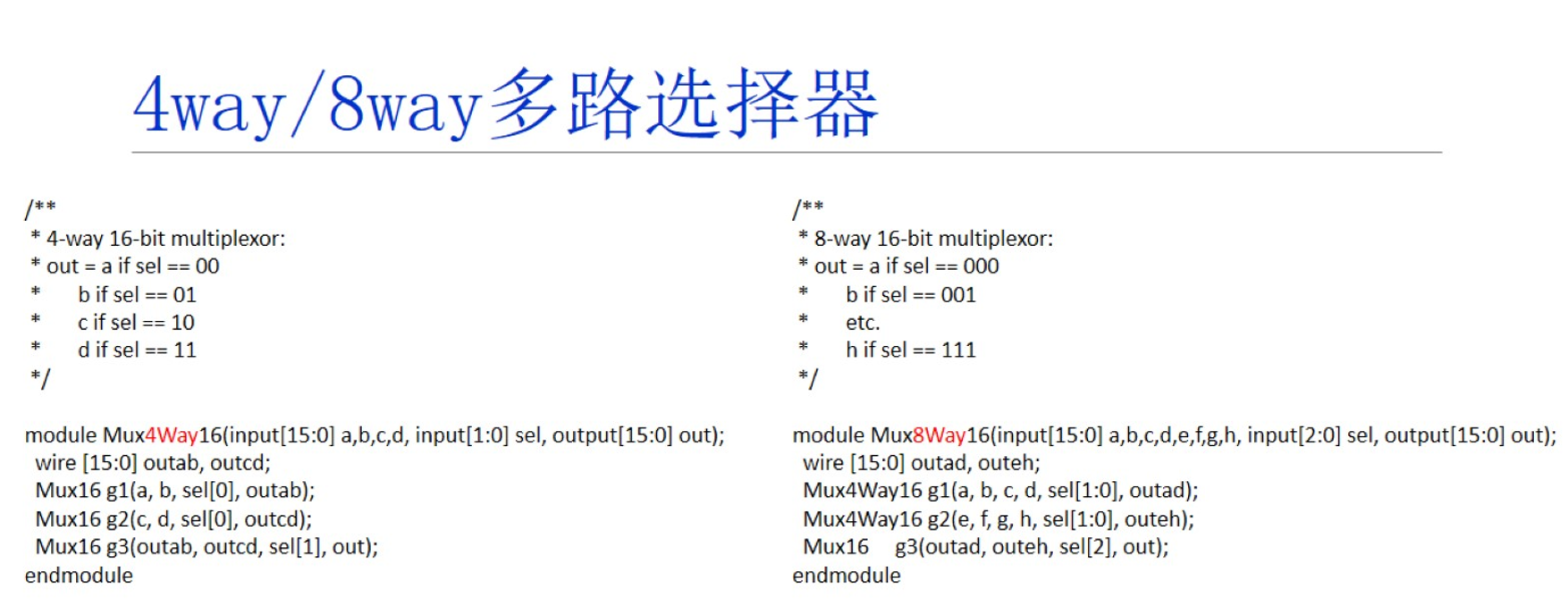
四路选择器代码实现
`ifndef mux4way16_V
`define mux4way16_V

`include "mux16.v"

module mux4way16(output [15:0] o, input [15:0] a, b, c, d, input [1:0] sel);
    wire [15:0] val1, val2;
    mux16 m0(val1, a, b, sel[0]);
    mux16 m1(val2, c, d, sel[0]);
    mux16 m2(o, val1, val2, sel[1]);
endmodule;
`endif
测试
`include "mux4way16.v"

module mux4way16_tb;
    reg [15:0] a, b, c, d;
    reg [1:0] sel;
    wire [15:0] out;

    mux4way16 dut(out, a, b, c, d, sel);

    initial begin
        $monitor("Time=%0t: a=%h, b=%h, c=%h, d=%h, sel=%b, out=%h",
                 $time, a, b, c, d, sel, out);

        // 测试用例1: sel=00时选择a
        a = 16'h0000; b = 16'h1111; c = 16'h2222; d = 16'h3333; sel = 2'b00; #10;

        // 测试用例2: sel=01时选择b
        a = 16'h0000; b = 16'h1111; c = 16'h2222; d = 16'h3333; sel = 2'b01; #10;

        // 测试用例3: sel=10时选择c
        a = 16'h0000; b = 16'h1111; c = 16'h2222; d = 16'h3333; sel = 2'b10; #10;

        // 测试用例4: sel=11时选择d
        a = 16'h0000; b = 16'h1111; c = 16'h2222; d = 16'h3333; sel = 2'b11; #10;

        // 测试用例5: 交替模式测试
        a = 16'hAAAA; b = 16'hBBBB; c = 16'hCCCC; d = 16'hDDDD;
        sel = 2'b00; #10;
        sel = 2'b01; #10;
        sel = 2'b10; #10;
        sel = 2'b11; #10;

        // 测试用例6: 随机值测试
        a = 16'h1234; b = 16'h5678; c = 16'h9ABC; d = 16'hDEF0;
        sel = 2'b00; #10;
        sel = 2'b01; #10;
        sel = 2'b10; #10;
        sel = 2'b11; #10;

        // 测试用例7: 边界值测试
        a = 16'h0000; b = 16'h0001; c = 16'hFFFE; d = 16'hFFFF;
        sel = 2'b00; #10;
        sel = 2'b01; #10;
        sel = 2'b10; #10;
        sel = 2'b11; #10;

        // 测试用例8: 全1和全0测试
        a = 16'h0000; b = 16'hFFFF; c = 16'h0000; d = 16'hFFFF;
        sel = 2'b00; #10;
        sel = 2'b01; #10;
        sel = 2'b10; #10;
        sel = 2'b11; #10;

        $finish;
    end
endmodule
八路选择器代码实现
`ifndef mux8way16_V
`define mux8way16_V

`include "mux4way16.v"
`include "mux16.v"

module mux8way16 (output [15:0] o, input [15:0] a, b, c, d, e, f, g, h, input [2:0] sel);
    wire [15:0] val1, val2;
    mux4way16 m0(val1, a, b, c, d, sel[1:0]);
    mux4way16 m1(val2, e, f, g, h, sel[1:0]);
    mux16 m2(o, val1, val2, sel[2]);
endmodule;
`endif
测试
`include "mux8way16.v"

module mux8way16_tb;
    reg [15:0] a, b, c, d, e, f, g, h;
    reg [2:0] sel;
    wire [15:0] out;

    mux8way16 dut(out, a, b, c, d, e, f, g, h, sel);

    initial begin
        $monitor("Time=%0t: a=%h, b=%h, c=%h, d=%h, e=%h, f=%h, g=%h, h=%h, sel=%b, out=%h",
                 $time, a, b, c, d, e, f, g, h, sel, out);

        // 测试用例1: sel=000时选择a
        a = 16'h0000; b = 16'h1111; c = 16'h2222; d = 16'h3333;
        e = 16'h4444; f = 16'h5555; g = 16'h6666; h = 16'h7777;
        sel = 3'b000; #10;

        // 测试用例2: sel=001时选择b
        a = 16'h0000; b = 16'h1111; c = 16'h2222; d = 16'h3333;
        e = 16'h4444; f = 16'h5555; g = 16'h6666; h = 16'h7777;
        sel = 3'b001; #10;

        // 测试用例3: sel=010时选择c
        a = 16'h0000; b = 16'h1111; c = 16'h2222; d = 16'h3333;
        e = 16'h4444; f = 16'h5555; g = 16'h6666; h = 16'h7777;
        sel = 3'b010; #10;

        // 测试用例4: sel=011时选择d
        a = 16'h0000; b = 16'h1111; c = 16'h2222; d = 16'h3333;
        e = 16'h4444; f = 16'h5555; g = 16'h6666; h = 16'h7777;
        sel = 3'b011; #10;

        // 测试用例5: sel=100时选择e
        a = 16'h0000; b = 16'h1111; c = 16'h2222; d = 16'h3333;
        e = 16'h4444; f = 16'h5555; g = 16'h6666; h = 16'h7777;
        sel = 3'b100; #10;

        // 测试用例6: sel=101时选择f
        a = 16'h0000; b = 16'h1111; c = 16'h2222; d = 16'h3333;
        e = 16'h4444; f = 16'h5555; g = 16'h6666; h = 16'h7777;
        sel = 3'b101; #10;

        // 测试用例7: sel=110时选择g
        a = 16'h0000; b = 16'h1111; c = 16'h2222; d = 16'h3333;
        e = 16'h4444; f = 16'h5555; g = 16'h6666; h = 16'h7777;
        sel = 3'b110; #10;

        // 测试用例8: sel=111时选择h
        a = 16'h0000; b = 16'h1111; c = 16'h2222; d = 16'h3333;
        e = 16'h4444; f = 16'h5555; g = 16'h6666; h = 16'h7777;
        sel = 3'b111; #10;

        // 测试用例9: 交替模式测试
        a = 16'hAAAA; b = 16'hBBBB; c = 16'hCCCC; d = 16'hDDDD;
        e = 16'hEEEE; f = 16'hFFFF; g = 16'h9999; h = 16'h8888;
        sel = 3'b000; #10;
        sel = 3'b001; #10;
        sel = 3'b010; #10;
        sel = 3'b011; #10;
        sel = 3'b100; #10;
        sel = 3'b101; #10;
        sel = 3'b110; #10;
        sel = 3'b111; #10;

        // 测试用例10: 随机值测试
        a = 16'h1234; b = 16'h5678; c = 16'h9ABC; d = 16'hDEF0;
        e = 16'h2468; f = 16'h1357; g = 16'hFACE; h = 16'hBEEF;
        sel = 3'b000; #10;
        sel = 3'b001; #10;
        sel = 3'b010; #10;
        sel = 3'b011; #10;
        sel = 3'b100; #10;
        sel = 3'b101; #10;
        sel = 3'b110; #10;
        sel = 3'b111; #10;

        // 测试用例11: 边界值测试
        a = 16'h0000; b = 16'h0001; c = 16'hFFFE; d = 16'hFFFF;
        e = 16'h7FFF; f = 16'h8000; g = 16'hAAAA; h = 16'h5555;
        sel = 3'b000; #10;
        sel = 3'b001; #10;
        sel = 3'b010; #10;
        sel = 3'b011; #10;
        sel = 3'b100; #10;
        sel = 3'b101; #10;
        sel = 3'b110; #10;
        sel = 3'b111; #10;

        $finish;
    end
endmodule
多路复用器的实现
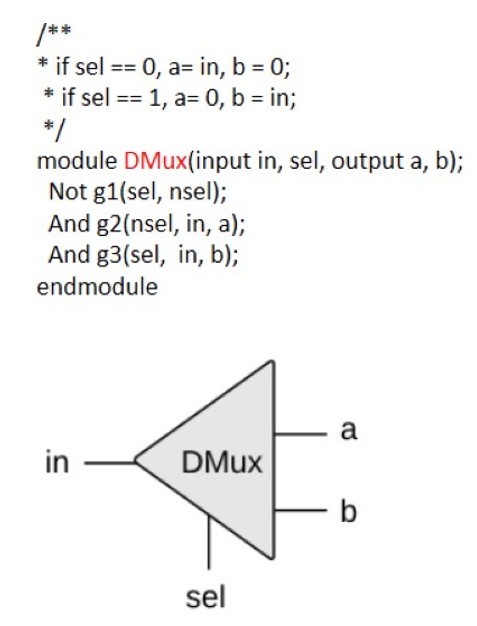
代码
`ifndef dmux_V
`define dmux_V

`include "a_not.v"
`include "a_and.v"


module dmux (output o1, o2, input val, input sel);
    wire n_sel;
    a_not a1(n_sel, sel);
    a_and and1(o1, n_sel, val);
    a_and and2(o2, sel, val);
endmodule;

`endif
测试
`include "dmux.v"

module dmux_tb;
    reg val, sel;
    wire o1, o2;

    dmux obj(o1, o2, val, sel);

    initial begin
        $monitor("Time=%0t: val=%b, sel=%b, o1=%b, o2=%b", $time, val, sel, o1, o2);

        val = 0; sel = 0; #10;
        val = 0; sel = 1; #10;
        val = 1; sel = 0; #10;
        val = 1; sel = 1; #10;

        $finish;
    end
endmodule
4Way/8Way多路复用器实现
代码
`ifndef dmux4way_V
`define dmux4way_V

`include "a_not.v"

module dmux4way (output a, b, c, d, input val, input [1:0] sel);
    wire n_sel0, n_sel1;
    a_not not1(n_sel0, sel[0]);
    a_not not2(n_sel1, sel[1]);

    assign a = val & n_sel1 & n_sel0;
    assign b = val & n_sel1 & sel[0];
    assign c = val & sel[1] & n_sel0;
    assign d = val & sel[1] & sel[0];
endmodule
`endif
测试
`include "dmux4way.v"

module dmux4way_tb;
    reg val;
    reg [1:0] sel;
    wire a, b, c, d;

    dmux4way dut(a, b, c, d, val, sel);

    initial begin
        $monitor("Time=%0t: val=%b, sel=%b, a=%b, b=%b, c=%b, d=%b",
                 $time, val, sel, a, b, c, d);

        // 测试所有选择情况
        val = 1'b0; sel = 2'b00; #10;
        val = 1'b0; sel = 2'b01; #10;
        val = 1'b0; sel = 2'b10; #10;
        val = 1'b0; sel = 2'b11; #10;

        val = 1'b1; sel = 2'b00; #10;
        val = 1'b1; sel = 2'b01; #10;
        val = 1'b1; sel = 2'b10; #10;
        val = 1'b1; sel = 2'b11; #10;

        $finish;
    end
endmodule
8Way多路复用器的实现
使用最高位sel[2]判断最终输出在高四位还是低四位, 记录为val1和val2
代码实现
`ifndef DMUX8WAY_V
`define DMUX8WAY_V

`include "dmux.v"
`include "dmux4way.v"

module dmux8way(output a, b, c, d, e, f, g, h, input val, input [2:0] sel);
    wire val1, val2;

    dmux dmux1(val1, val2, val, sel[2]);

    dmux4way way1(a, b, c, d, val1, sel[1:0]);
    dmux4way way2(e, f, g, h, val2, sel[1:0]);
endmodule

`endif
测试
`timescale 1ns/1ps
`include "dmux8way.v"

module dmux8way_tb;
    reg val;
    reg [2:0] sel;
    wire a, b, c, d, e, f, g, h;

    // 实例化被测模块
    dmux8way uut(
        .a(a), .b(b), .c(c), .d(d),
        .e(e), .f(f), .g(g), .h(h),
        .val(val), .sel(sel)
    );

    initial begin
        // 初始化
        $display("Starting dmux8way testbench...");
        val = 1'b1;

        // 测试所有选择情况
        for (sel = 0; sel < 8; sel = sel + 1) begin
            #10;
            $display("sel=%b, outputs=%b%b%b%b%b%b%b%b",
                     sel, a, b, c, d, e, f, g, h);
        end

        // 添加额外的延迟确保所有信号稳定
        #20;

        $display("Test completed successfully!");
        $finish;  // 确保程序终止
    end
endmodule
SR锁存器存储一位数据
使用两个或非门实现SR锁存器
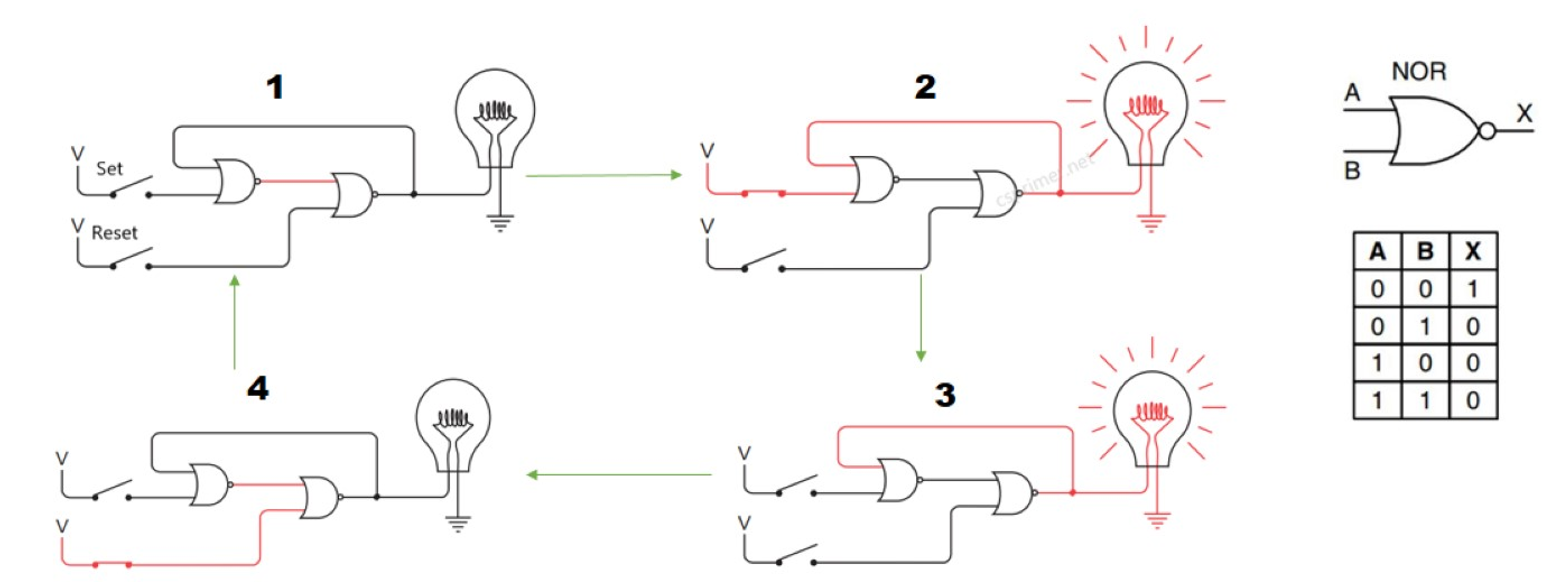
第一个开关是set, 第二个开关是reset
- 初始状态电灯是关闭
- 接通
set开关, 第一个或非门输出变为0, 第二个或非门输出为1, 电灯点亮, 第二个或非门的输出又作为第一个或非门的输入 - 将
set断开, 发现第一个或非门依旧有一个输入是1, 实现了存储一位数据的功能 - 将
reset开关闭合, 电路被重置到第一个状态
SR锁存器的真值表
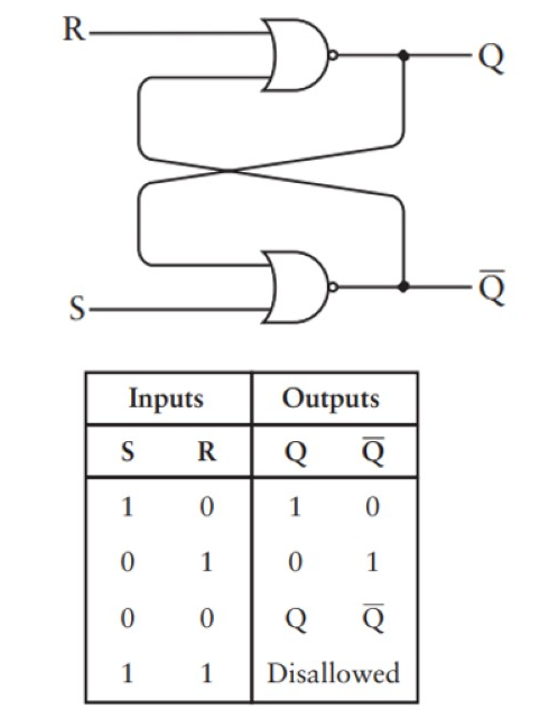
当S和R输入都是1, 不符合SR锁存器的设置, 一般要避免这种情况
一般使用时钟控制SR锁存器, 当时钟是1可以进行操作, 时钟是0保持上一个时钟的状态
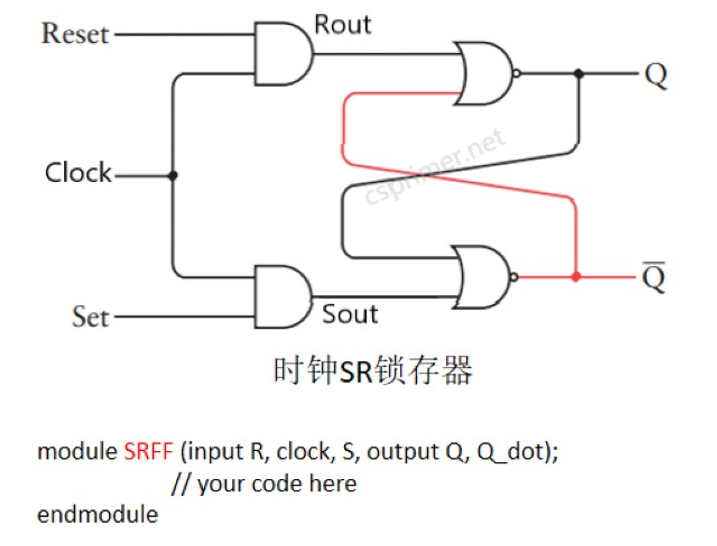
代码实现
`ifndef SRFF_V
`define SRFF_V

`include "a_and.v"
`include "a_nor.v"

module srff (output q, q_not, input r, c, s);
    wire new_s, new_r;
    a_and and1(new_s, s, c);
    a_and and2(new_r, r, c);

    a_nor nor1(q, new_r, q_not);
    a_nor nor2(q_not, new_s, q);
endmodule;

`endif
测试
`include "srff.v"

module srff_tb;
    reg r, s, c;
    wire q, q_not;

    // 实例化SR锁存器,正确连接端口
    srff obj(q, q_not, r, c, s);

    initial begin
        $monitor("Time=%0t: c=%b, s=%b, r=%b, q=%b, q_not=%b", $time, c, s, r, q, q_not);

        // 初始化
        c = 0; s = 0; r = 0; #10;

        // 测试时钟为低电平时,输入变化不影响输出
        c = 0; s = 1; r = 0; #10;
        c = 0; s = 0; r = 1; #10;

        c = 1; s = 1; r = 0; #10;  // 置位
        c = 1; s = 0; r = 0; #10;  // 保持
        c = 1; s = 0; r = 1; #10;  // 复位
        c = 1; s = 0; r = 0; #10;  // 保持

        // 测试禁止状态 (s=1, r=1)
        c = 1; s = 1; r = 1; #10;

        // 时钟下降沿后测试保持
        c = 0; s = 1; r = 0; #10;
        c = 0; s = 0; r = 1; #10;

        $finish;
    end
endmodule
D锁存器
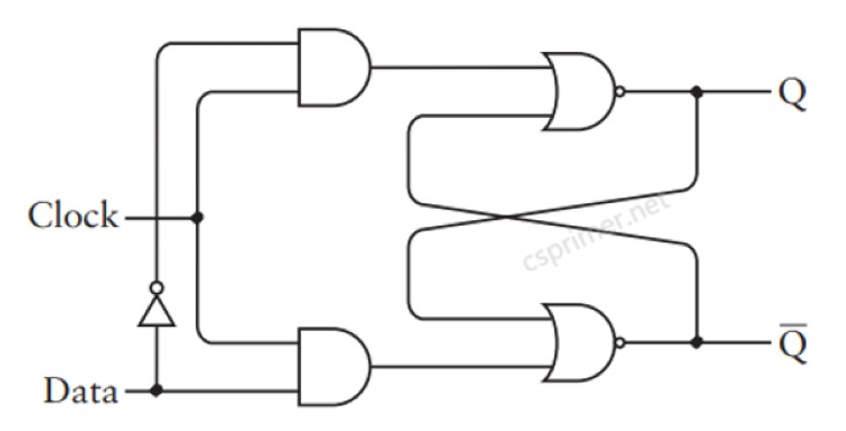
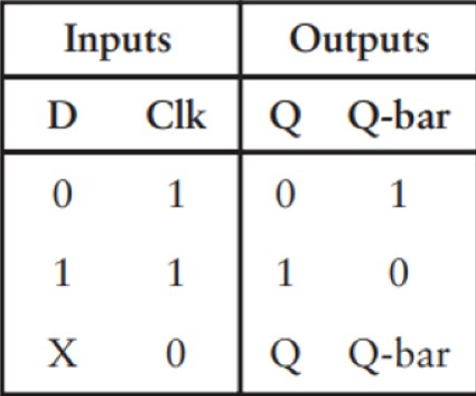
就是将SR锁存器的两个输入变为一个输入, 这样就可以避免将S和R造成相同的输入, 这种也叫电平触发, 当时钟为1的时候, 输出等于输入, 当时钟是0, 保持原来的值
边沿触发的D触发器
时钟从0变成1, 输出等于输入, 其他情况输出不受输入影响
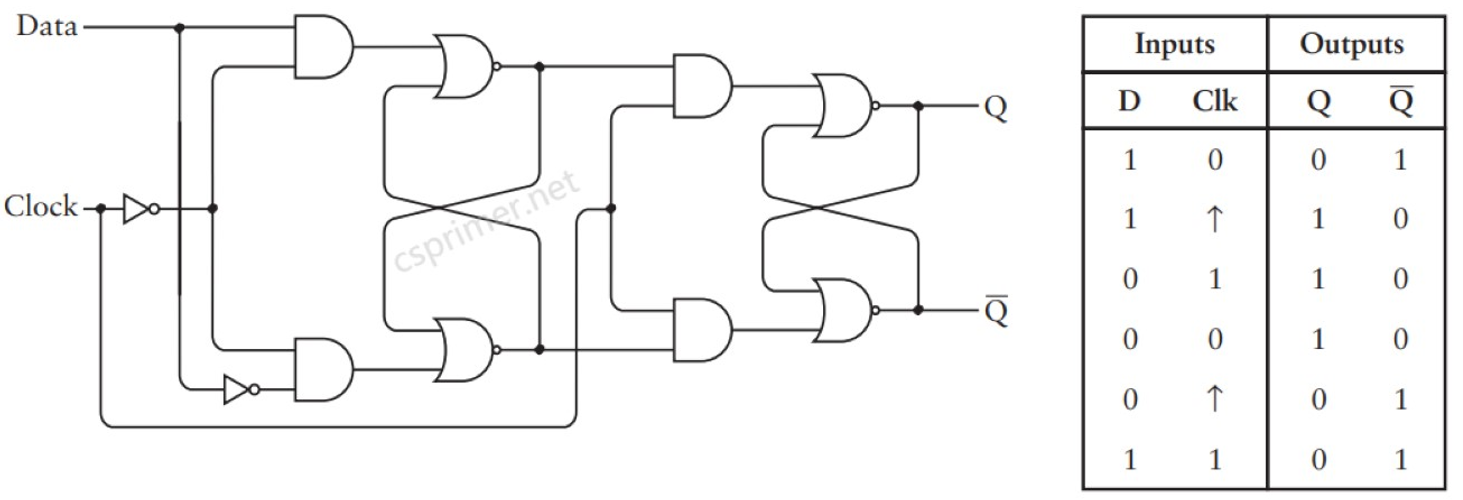
实际就是由两个D触发器构成, 前面的D触发器是时钟在0的时候存储数据, 后面的D触发器是时钟在1的时候存储数据
假设当前时钟是0, 数据为1, 前面的触发器将1存储, 此时下一时刻的时钟信号变为1, 前面的触发器将数据释放并且置0, 后面的触发器将前面触发器释放的数据进行存储, 这样就实现了上升沿的触发器
D触发器的实现
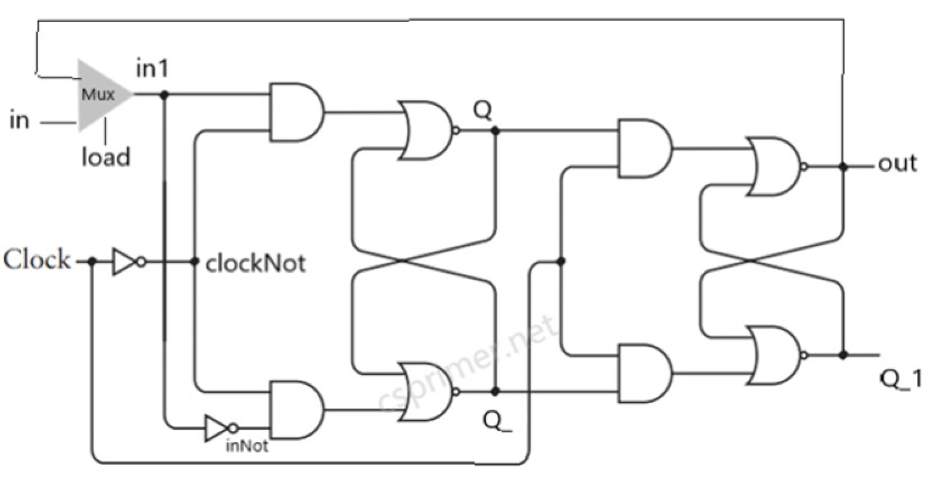
实际使用过程中, 添加一个load, 当load == 0的时候, 输入是原来的输出, 否则才能对该锁存器进行数据写入的操作
代码实现
`ifndef DFF_V
`define DFF_V

`include "a_not.v"
`include "mux.v"
`include "a_and.v"
`include "a_nor.v"
`include "srff.v"

module dff(output q, input d, c, load);

    wire val;
    mux mux1(val, q, d, load);

    wire val_not, c_not;
    a_not not1(val_not, val);
    a_not not2(c_not, c);

    wire tmp, tmp_not, q_not;
    srff srff1(tmp, tmp_not, val, c_not, val_not);
    srff srff2(q, q_not, tmp, c, tmp_not);
endmodule;

`endif
测试
`include "dff.v"

module dff_tb;
    reg in, clk, load;
    wire out, out1;

    // 实例化D触发器
    dff obj(out, in, clk, load);

    // 时钟生成:每20个时间单位翻转一次
    always #20 clk = ~clk;

    initial begin
        // 初始化VCD文件用于波形查看
        $dumpfile("dff.vcd");
        $dumpvars(0, dff_tb);

        // 初始化信号
        clk = 0;
        in = 1;
        load = 1;

        // 采用第一段代码的测试序列
        #10
        #10
        #10
        in = 0;
        #10
        #10
        #10
        #10
        load = 0;
        #10
        in = 1;
        #10
        #10 $finish;
    end

    initial begin
        // 监控信号变化,使用第一段代码的格式
        $monitor($time,,,"in=%d clk=%d load=%d out=%d", in, clk, load, out);
    end

endmodule
16位寄存器
将16个上述的触发器构造起来变成一个16位的寄存器
代码实现
`ifndef register16_V
`define register16_V

`include "dff.v"

module register16(output [15:0] out, input [15:0] d, input c, load);
    dff dff0(out[0], d[0], c, load);
    dff dff1(out[1], d[1], c, load);
    dff dff2(out[2], d[2], c, load);
    dff dff3(out[3], d[3], c, load);
    dff dff4(out[4], d[4], c, load);
    dff dff5(out[5], d[5], c, load);
    dff dff6(out[6], d[6], c, load);
    dff dff7(out[7], d[7], c, load);
    dff dff8(out[8], d[8], c, load);
    dff dff9(out[9], d[9], c, load);
    dff dff10(out[10], d[10], c, load);
    dff dff11(out[11], d[11], c, load);
    dff dff12(out[12], d[12], c, load);
    dff dff13(out[13], d[13], c, load);
    dff dff14(out[14], d[14], c, load);
    dff dff15(out[15], d[15], c, load);
endmodule;
`endif
测试
`include "register16.v"

module register16_tb;
    reg [15:0] d;
    reg c, load;
    wire [15:0] out;

    // 实例化16位寄存器
    register16 obj(out, d, c, load);

    // 时钟生成:每20个时间单位翻转一次
    always #20 c = ~c;

    initial begin
        // 初始化VCD文件用于波形查看
        $dumpfile("register16.vcd");
        $dumpvars(0, register16_tb);

        // 初始化信号
        c = 0;
        d = 16'h0000;
        load = 1;

        // 测试序列
        #10
        d = 16'hAAAA;  // 1010101010101010
        #10
        #10
        d = 16'h5555;  // 0101010101010101
        #10
        #10
        #10
        #10
        load = 0;      // 禁用加载
        #10
        d = 16'hFFFF;  // 数据变化但load=0,输出不应改变
        #10
        #10
        load = 1;      // 重新启用加载
        d = 16'h1234;  // 新数据
        #10
        #10 $finish;
    end

    initial begin
        // 监控信号变化
        $monitor($time,,,"d=%h c=%d load=%d out=%h", d, c, load, out);
    end

endmodule
RAM8随机存储器
将八个寄存器组合成一个RAM8, 通过地址来寻址, 一个二进制数代表一个16位地址
load == 1并且当前波形是上升沿写入数据, 否则是读取数据, address控制写入或者读取的地址
代码实现
`ifndef RAM8_V
`define RAM8_V

`include "register16.v"
`include "dmux8way.v"
`include "mux8way16.v"

module ram8(output [15:0] o, input [15:0] d, input [2:0] address, input c, load);
    wire l0, l1, l2, l3, l4, l5, l6, l7;
    dmux8way way1(l0, l1, l2, l3, l4, l5, l6, l7, load, address);

    wire [15:0] r0, r1, r2, r3, r4, r5, r6, r7;
    register16 reg0(r0, d, c, l0);
    register16 reg1(r1, d, c, l1);
    register16 reg2(r2, d, c, l2);
    register16 reg3(r3, d, c, l3);
    register16 reg4(r4, d, c, l4);
    register16 reg5(r5, d, c, l5);
    register16 reg6(r6, d, c, l6);
    register16 reg7(r7, d, c, l7);

    mux8way16 way2(o, r0, r1, r2, r3, r4, r5, r6, r7, address);

endmodule;

`endif
测试
`include "ram8.v"

module ram8_tb;
    reg [15:0] d;
    reg [2:0] address;
    reg c, load;
    wire [15:0] out;

    // 实例化RAM8模块
    ram8 obj(out, d, address, c, load);

    // 时钟生成:每20个时间单位翻转一次
    always #20 c = ~c;

    initial begin
        // 初始化VCD文件用于波形查看
        $dumpfile("ram8.vcd");
        $dumpvars(0, ram8_tb);

        // 初始化信号
        c = 0;
        d = 16'h0000;
        address = 3'b000;
        load = 0;

        // 测试序列
        #10

        // 测试1:向不同地址写入数据
        $display("=== 写入测试 ===");
        load = 1;  // 启用写入

        // 向地址0写入数据
        address = 3'b000;
        d = 16'hAAAA;
        #40

        // 向地址1写入数据
        address = 3'b001;
        d = 16'h5555;
        #40

        // 向地址2写入数据
        address = 3'b010;
        d = 16'h1234;
        #40

        // 向地址3写入数据
        address = 3'b011;
        d = 16'h5678;
        #40

        // 向地址4写入数据
        address = 3'b100;
        d = 16'h9ABC;
        #40

        // 向地址5写入数据
        address = 3'b101;
        d = 16'hDEF0;
        #40

        // 向地址6写入数据
        address = 3'b110;
        d = 16'h2468;
        #40

        // 向地址7写入数据
        address = 3'b111;
        d = 16'h1357;
        #40

        // 测试2:读取不同地址的数据(load=0)
        $display("=== 读取测试 ===");
        load = 0;  // 禁用写入,启用读取

        // 读取地址0
        address = 3'b000;
        #40

        // 读取地址1
        address = 3'b001;
        #40

        // 读取地址2
        address = 3'b010;
        #40

        // 读取地址3
        address = 3'b011;
        #40

        // 读取地址4
        address = 3'b100;
        #40

        // 读取地址5
        address = 3'b101;
        #40

        // 读取地址6
        address = 3'b110;
        #40

        // 读取地址7
        address = 3'b111;
        #40

        // 测试3:验证写入时读取功能
        $display("=== 写入时读取测试 ===");
        load = 1;  // 启用写入

        // 向地址0写入新数据,同时验证输出是否正确
        address = 3'b000;
        d = 16'hFFFF;
        #40

        // 读取其他地址,验证数据是否保持
        load = 0;
        address = 3'b001;
        #40
        address = 3'b010;
        #40

        // 测试4:验证load=0时数据不变
        $display("=== 写保护测试 ===");
        address = 3'b000;
        #20
        load = 0;      // 禁用写入
        d = 16'h9999;  // 数据变化但load=0,存储器不应改变
        #40
        load = 1;      // 重新启用写入
        d = 16'h7777;  // 新数据应该被写入
        #40

        // 最终读取验证所有数据
        $display("=== 最终验证 ===");
        load = 0;
        for (integer i = 0; i < 8; i = i + 1) begin
            address = i;
            #40;
        end

        #20 $finish;
    end

    initial begin
        // 监控信号变化
        $monitor($time,,,"addr=%b d=%h c=%d load=%d out=%h",
                address, d, c, load, out);
    end

endmodule
RAM64随机存储器
地址范围[5:0], 使用[5:3]段地址判断在哪个RAM8, 剩余直接调用RAM8模块
代码实现
`ifndef RAM64_V
`define RAM64_V

`include "ram8.v"
`include "dmux8way.v"
`include "mux8way16.v"

module ram64(output [15:0] o, input [15:0] d, input [5:0] address, input c, load);
    wire l0, l1, l2, l3, l4, l5, l6, l7;
    dmux8way way1(l0, l1, l2, l3, l4, l5, l6, l7, load, address[5:3]);

    wire [15:0] r0, r1, r2, r3, r4, r5, r6, r7;

    ram8 reg0(r0, d, address[2:0], c, l0);
    ram8 reg1(r1, d, address[2:0], c, l1);
    ram8 reg2(r2, d, address[2:0], c, l2);
    ram8 reg3(r3, d, address[2:0], c, l3);
    ram8 reg4(r4, d, address[2:0], c, l4);
    ram8 reg5(r5, d, address[2:0], c, l5);
    ram8 reg6(r6, d, address[2:0], c, l6);
    ram8 reg7(r7, d, address[2:0], c, l7);

    mux8way16 way2(o, r0, r1, r2, r3, r4, r5, r6, r7, address[5:3]);
endmodule;

`endif
测试
`include "ram64.v"

module ram64_tb;
    reg [15:0] d;
    reg [5:0] address;
    reg c, load;
    wire [15:0] out;

    // Instantiate RAM64 module
    ram64 obj(out, d, address, c, load);

    // Clock generation: toggle every 20 time units
    always #20 c = ~c;

    initial begin
        // Initialize VCD file for waveform viewing
        $dumpfile("ram64.vcd");
        $dumpvars(0, ram64_tb);

        // Initialize signals
        c = 0;
        d = 16'h0000;
        address = 6'b000000;
        load = 0;

        // Test sequence
        #10

        // Test 1: Write to same offset in different RAM8 modules
        $display("=== Test 1: Different RAM8 modules, same offset ===");
        load = 1;  // Enable write

        // Write to address 0 of 8 different RAM8 modules
        address = 6'b000000;  // RAM8 module 0, address 0
        d = 16'h1111;
        #40

        address = 6'b001000;  // RAM8 module 1, address 0
        d = 16'h2222;
        #40

        address = 6'b010000;  // RAM8 module 2, address 0
        d = 16'h3333;
        #40

        address = 6'b011000;  // RAM8 module 3, address 0
        d = 16'h4444;
        #40

        address = 6'b100000;  // RAM8 module 4, address 0
        d = 16'h5555;
        #40

        address = 6'b101000;  // RAM8 module 5, address 0
        d = 16'h6666;
        #40

        address = 6'b110000;  // RAM8 module 6, address 0
        d = 16'h7777;
        #40

        address = 6'b111000;  // RAM8 module 7, address 0
        d = 16'h8888;
        #40

        // Test 2: Write to different addresses in same RAM8 module
        $display("=== Test 2: Same RAM8 module, different addresses ===");

        // Write multiple addresses in RAM8 module 0
        address = 6'b000001;  // RAM8 module 0, address 1
        d = 16'hAAAA;
        #40

        address = 6'b000010;  // RAM8 module 0, address 2
        d = 16'hBBBB;
        #40

        address = 6'b000011;  // RAM8 module 0, address 3
        d = 16'hCCCC;
        #40

        address = 6'b000100;  // RAM8 module 0, address 4
        d = 16'hDDDD;
        #40

        address = 6'b000101;  // RAM8 module 0, address 5
        d = 16'hEEEE;
        #40

        address = 6'b000110;  // RAM8 module 0, address 6
        d = 16'hFFFF;
        #40

        address = 6'b000111;  // RAM8 module 0, address 7
        d = 16'h9999;
        #40

        // Test 3: Read verification
        $display("=== Test 3: Read verification ===");
        load = 0;  // Disable write, enable read

        // Verify address 0 of different RAM8 modules
        address = 6'b000000;  // Should output 1111
        #40
        address = 6'b001000;  // Should output 2222
        #40
        address = 6'b010000;  // Should output 3333
        #40
        address = 6'b011000;  // Should output 4444
        #40
        address = 6'b100000;  // Should output 5555
        #40
        address = 6'b101000;  // Should output 6666
        #40
        address = 6'b110000;  // Should output 7777
        #40
        address = 6'b111000;  // Should output 8888
        #40

        // Verify all addresses in RAM8 module 0
        address = 6'b000000;  // address 0: 1111
        #40
        address = 6'b000001;  // address 1: AAAA
        #40
        address = 6'b000010;  // address 2: BBBB
        #40
        address = 6'b000011;  // address 3: CCCC
        #40
        address = 6'b000100;  // address 4: DDDD
        #40
        address = 6'b000101;  // address 5: EEEE
        #40
        address = 6'b000110;  // address 6: FFFF
        #40
        address = 6'b000111;  // address 7: 9999
        #40

        // Test 4: Boundary address test
        $display("=== Test 4: Boundary address test ===");
        load = 1;

        // Test minimum address
        address = 6'b000000;
        d = 16'h1234;
        #40

        // Test maximum address
        address = 6'b111111;
        d = 16'h5678;
        #40

        // Test middle address
        address = 6'b100011;  // RAM8 module 4, address 3
        d = 16'h9ABC;
        #40

        load = 0;
        // Verify boundary addresses
        address = 6'b000000;
        #40
        address = 6'b111111;
        #40
        address = 6'b100011;
        #40

        // Test 5: Write protection test
        $display("=== Test 5: Write protection test ===");
        address = 6'b010101;  // RAM8 module 2, address 5
        #20
        load = 0;      // Disable write
        d = 16'hFFFF;  // Data changes but load=0, memory should not change
        #40
        load = 1;      // Re-enable write
        d = 16'h5555;  // New data should be written
        #40

        // Final comprehensive verification
        $display("=== Final comprehensive verification ===");
        load = 0;

        // Quick scan of key addresses
        address = 6'b000000;
        #20
        address = 6'b000111;
        #20
        address = 6'b111000;
        #20
        address = 6'b111111;
        #20
        address = 6'b100011;
        #20

        #20 $finish;
    end

    initial begin
        // Monitor signal changes
        $monitor($time,,,"addr=%6b d=%h c=%d load=%d out=%h",
                address, d, c, load, out);
    end

endmodule
RAM512随机存储器
原理与上述一致, 调用8个RAM64实现
代码实现
`ifndef RAM512_V
`define RAM512_V

`include "ram64.v"
`include "dmux8way.v"
`include "mux8way16.v"

module ram512(output [15:0] o, input [15:0] d, input [8:0] address, input c, load);
    wire l0, l1, l2, l3, l4, l5, l6, l7;
    dmux8way way1(l0, l1, l2, l3, l4, l5, l6, l7, load, address[8:6]);

    wire [15:0] r0, r1, r2, r3, r4, r5, r6, r7;
    ram64 reg0(r0, d, address[5:0], c, l0);
    ram64 reg1(r1, d, address[5:0], c, l1);
    ram64 reg2(r2, d, address[5:0], c, l2);
    ram64 reg3(r3, d, address[5:0], c, l3);
    ram64 reg4(r4, d, address[5:0], c, l4);
    ram64 reg5(r5, d, address[5:0], c, l5);
    ram64 reg6(r6, d, address[5:0], c, l6);
    ram64 reg7(r7, d, address[5:0], c, l7);

    mux8way16 way2(o, r0, r1, r2, r3, r4, r5, r6, r7, address[8:6]);
endmodule;

`endif
测试
`include "ram512.v"

module ram512_tb;
    reg [15:0] d;
    reg [8:0] address;
    reg c, load;
    wire [15:0] o;

    ram512 uut(o, d, address, c, load);

    always #20 c = ~c;

    initial begin
        $dumpfile("ram512.vcd");
        $dumpvars(0, ram512_tb);

        c = 0;
        d = 16'h0000;
        address = 9'b000000000;
        load = 0;

        #10;

        // Test 1: Write to different RAM64 modules
        $display("=== Test 1: Write to different RAM64 modules ===");
        load = 1;

        address = 9'b000000000;
        d = 16'h1111;
        #40;

        address = 9'b001000000;
        d = 16'h2222;
        #40;

        address = 9'b010000000;
        d = 16'h3333;
        #40;

        address = 9'b011000000;
        d = 16'h4444;
        #40;

        address = 9'b100000000;
        d = 16'h5555;
        #40;

        address = 9'b101000000;
        d = 16'h6666;
        #40;

        address = 9'b110000000;
        d = 16'h7777;
        #40;

        address = 9'b111000000;
        d = 16'h8888;
        #40;

        // Test 2: Different addresses within RAM64 module 0
        $display("=== Test 2: Different addresses within RAM64 module 0 ===");

        address = 9'b000000001;
        d = 16'hAAAA;
        #40;

        address = 9'b000000010;
        d = 16'hBBBB;
        #40;

        address = 9'b000000011;
        d = 16'hCCCC;
        #40;

        address = 9'b000000100;
        d = 16'hDDDD;
        #40;

        // Test 3: Read verification
        $display("=== Test 3: Read verification ===");
        load = 0;

        address = 9'b000000000;
        #40;
        address = 9'b001000000;
        #40;
        address = 9'b010000000;
        #40;
        address = 9'b011000000;
        #40;
        address = 9'b100000000;
        #40;
        address = 9'b101000000;
        #40;
        address = 9'b110000000;
        #40;
        address = 9'b111000000;
        #40;

        address = 9'b000000000;
        #40;
        address = 9'b000000001;
        #40;
        address = 9'b000000010;
        #40;
        address = 9'b000000011;
        #40;
        address = 9'b000000100;
        #40;

        // Test 4: Boundary address test
        $display("=== Test 4: Boundary address test ===");
        load = 1;

        address = 9'b000000000;
        d = 16'h1234;
        #40;

        address = 9'b111111111;
        d = 16'h5678;
        #40;

        address = 9'b100000011;
        d = 16'h9ABC;
        #40;

        load = 0;
        address = 9'b000000000;
        #40;
        address = 9'b111111111;
        #40;
        address = 9'b100000011;
        #40;

        // Test 5: Write protection test
        $display("=== Test 5: Write protection test ===");
        address = 9'b010000101;
        #20;
        load = 0;
        d = 16'hFFFF;
        #40;
        load = 1;
        d = 16'h5555;
        #40;

        // Final verification
        $display("=== Final verification ===");
        load = 0;

        address = 9'b000000000;
        #20;
        address = 9'b111111111;
        #20;
        address = 9'b100000011;
        #20;

        #20 $finish;
    end

    initial begin
        $monitor("Time=%0t addr=%9b d=%h c=%b load=%b out=%h",
                $time, address, d, c, load, o);
    end

endmodule
RAM16K随机存储器
代码实现
代码中reg[15:0] m[0:2**14-1]; , 的意思是声明寄存器组, 地址范围[0, 2 ^ 13]
`ifndef RAM16K_V
`define RAM16K_V

module RAM16K(
    output[15:0] out,
    input[15:0] d,
    input clock,
    input load,
    input[13:0] address
);

    reg[15:0] m[0:2**14-1];

    assign out = m[address];

    // 时序逻辑:在时钟上升沿执行写入操作
    always @(posedge clock) begin
        if (load)
            m[address] = d;
    end

endmodule

`endif

 京公网安备 11010502036488号